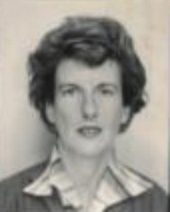
Cecily Mackworth was born on August 15, 1911 in Llantilio Pertholey, Wales. Although her mother moved to South West England after her father was killed in battle on the Western Front in 1914, Mackworth always considered herself Welsh.
Her aunt, Lady Rhondda, was instrumental in securing her a place at the London School of Economics for a two-year diploma in journalism in 1929. After this, Mackworth worked in Hungary and Germany and, after returning to London, married Belgian lawyer Léon Donckier de Donceel, moving to Brussels with him in 1935. They had a daughter Pascale Léonie Juliette in 1936. In 1938, her sister Helen died by suicide after her fiancé was shot and killed by his mother. Two months later, Mackworth’s husband died from tuberculosis.
After her husband’s death, Mackworth settled in Paris, first renting a flat in the Rue du Moulin Vert in the 14th arrondissement and later moving to Jeanne Bucher’s art gallery in the Boulevard Montparnasse. Aside from teaching and studying, she also entered the literary circle of Henry Miller (who published her poems in an offshoot of his magazine The Booster), and Lawrence Durrell.
After the start of WWII, Mackworth worked with Rose Adler at her Books for the Army circulating library, where she met René Gimpel, of whom she said, “I learned from him more than I have learned from anyone else, before or since.” As the war got closer, they closed down the library, conceding “the French Army was unlikely to do much reading in the near future”. She then became a Red Cross volunteer at the Gare d’Austerlitz.
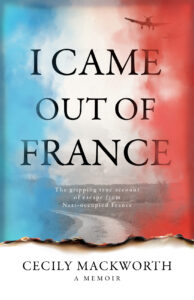
In 1940, Mackworth escaped Nazi-occupied France to England via Spain and Portugal, a journey that was recounted in her 1941 memoir I Came Out of France. She remained in England throughout the rest of the war, working for the Free French, the Army Bureau of Current Affairs, where she led discussion groups on social issues, and lecturing for Alliance Française. She also published Czechoslovakia Fights Back, chronicling the resistance to the Nazi occupation, in 1942, and Czechoslovakia the following year.
Mackworth returned to France in 1946, finding post-war Paris initially to be “fresh and exciting”, but later, after the excitement had worn off, she felt society was “caught between nostalgia for the past and disillusionment about the present”. She continued to write and published both François Villon: A Study, and A Mirror for French Poetry, 1840-1940 in 1947. Later that year, she was sent to Palestine as a newspaper correspondent and went again in 1949 to cover, as one of only two female reporters, the ending of the British Mandate, describing it as “a country where people are making a fresh start, a country about to be born”. Her experiences there were shared in her book The Mouth of the Sword.
She continued her real-life adventures in the 1954 book The Destiny of Isabelle Eberhardt, in which she retraced the footsteps of Eberhardt across the Algerian Sahara. Mackworth also published two novels: Spring’s Green Shadow in 1952 and Lucy’s Nose in 1992, and her biography Guillaume Apollinaire and the Cubist Life received the Darmstadt Award in 1961. She went on to publish her own memoir Ends of the World in 1987.
She married her second husband, the Marquis de Chabannes La Palice in 1956, and they stayed together, living in Normandy and Paris, until his death in 1980. Mackworth would be buried next to him in Normandy after her death in 2006, not long after finishing another memoir Out of the Black Mountains.